Do investors care about sustainability?

They say they do, but companies are not good at giving them what they need – or so I found out during a conference we held this week at my consultancy, Corporate Citizenship. 
Yesterday was a first for us at Corporate Citizenship.  We’ve been working with companies for over 20 years now, and for the first time we brought together in one room representatives of the investor community for a face-to-face dialogue with those in companies charged with explaining how they approach sustainability.  And a powerful discussion it was too, all part of our continuing Long Term Value Project.

‘IR meets CR’, we called it.  Speakers came from Schroders, MSCI, Aberdeen Standard Investments, Royal Bank of Scotland, Total, Stora Enso and more.  You can get a tweet-by-tweet account of how it went here. Some 150 people participated, kindly hosted at Chartered Accountants Hall in London by the ICAEW and run in partnership with the Investor Relations Society. It was especially pleasing for me to be back at the ICAEW: when I was training to get my accountancy qualification, these topics were not on the syllabus at all.

Our proposition was that there’s a disconnect between corporate responsibility
Continue reading

’Tis the season of… too much consumption, and year end predictions

 As the year 2017 draws to a close, I’ll hazard a prediction about a rising trend for 2018 – a backlash by consumers about how companies use their data.

As I write, here in London the shops are full. Households are preparing for the Christmas season, when Christians astutely adopt the pagan winter solstice festival to mark new beginnings and everyone settles in against the cold for an excess of consumption.

If the advertisements are to be believed, high on Santa’s list of presents this year will be smart speakers – with Amazon Echo battling it out with Google Home, since Apple has announced that its HomePod will not be shipped until early 2018. New on the scene is the Echo Dot, small enough to slip into anyone’s Christmas stocking.

If you’ve not yet joined the fun (and I’m firmly resisting so far) these devices harness voice controlled AI assistants – Amazon Alexa joining iPhone’s Siri, Microsoft Cortana and Google Now out in the cloud – to give you a hands-free way to play music, control your ‘smart home’ devices, tell you the weather forecast, and much more.

Continue reading

The impact potential – next steps on corporate community investment

Two decades ago, a few pioneering companies came together in London to form a benchmarking group and that has now gone worldwide.  So what’s next for community investment?

 Last week I spent an energising day in the company of 70 corporates from our LBG network and came away with three thoughts on how business/community partnerships should change if they are to remain relevant to the challenges of our times.

LBG started out with just six companies 20 years ago and has today grown into the global standard for measuring corporate community investment.  That’s why companies committed to increasing their social impact use it, over a thousand now, large and small, across all sectors.  Last week’s participants included not just the usual UK blue-chips, but firms as diverse as Nokia from Finland, EDP from Portugal, DP World out of Dubai and the Australian retailer Myers. Continue reading

The change election – time for business to decide

With the election battle gathering pace in the UK, big business is keeping its head down, despite having much at stake. Mike Tuffrey reads the early runes as the contest unfolds.

The pundits will tell you that political parties adopt one of two positions in elections – either “it’s time for a change” or “things are getting better, don’t let the other lot ruin it”. This time, however, that isn’t the choice on offer; everybody seems to be promoting a change agenda of some sort.

As I write this, the parties are busy publishing their manifestos. I’ll do an analysis once they are all out. Still, enough has been leaked or deliberately trailed to hazard a prediction: this is not a change or status quo battle, or a conventional left/right choice where one side says we need more government and one argues for less.

Continue reading

The price of democracy: defending civil society

Companies should do more to protect civil society, even if that means defending their critics from oppressive governments.

Think of business involvement in politics, and the murky world of backhanders and behind-the-scenes lobbying may spring to mind. However, define the issue as protecting basic freedoms –the sort of freedoms that companies need if they are to prosper in open and competitive markets – and a different perspective emerges.

So it was refreshing to hear a call, as I did last week, for companies to get more involved, not in party politics or the direct business of government but in defending the space for civil society to operate freely. That came during an event we at Corporate Citizenship organised with Danny Sriskandarajah, secretary general of CIVICUS, the global alliance of over 3,600 civil society organisations and activists working to strengthen citizen action and civil society around the world. Continue reading

Take responsibility

When Uber’s boss fell out with one of his drivers, the video went viral. In the process he’s taught us all a lesson about true responsibility.

It’s pretty ironic, I suppose. The digital revolution has enabled Uber co-founder, Travis Kalanick, to build a business worth a cool $70 billion in just eight years. Then the same technology and a humble dash-cam captured his angry exchange with one of their drivers, Fawzi Kamel, and it went round the world in seconds, thanks to a judicious leak to Bloomberg Technology.

Their argument started over tough changes to the business model of Uber’s high-end chauffeur service and ended with Kalanick uttering the priceless words “some people don’t like to take responsibility for their own shit” – thereby both passing the buck for the hapless driver’s bankruptcy and also – it seems to me – serving as a metaphor for the challenges facing global capitalism today.

It’s doubly ironic coming from such a profoundly disruptive business, Continue reading

Why ESG matters

It’s not exactly as easy as ABC, but ESG – Environmental, Social and Governance – is the key to investors getting traction on the behaviour of companies they own. 

Forgive me if a note of grumpiness creeps into this comment. That’s entirely due to too much Trumpiness at present. But I just couldn’t resist giving a little tongue-in-cheek cheer when I saw this year’s Most Controversial Companies Report from RepRisk.

This identifies the ten companies most at reputational risk from governance problems like corruption and fraud, as well as environmental and social controversies. For once, the rating is based on a rigorous analysis rather than social media chatter or NGO high profile campaigns. The aim of the exercise is to raise awareness of the ESG risks that need to be addressed by global corporations.

To be honest, I’ve become a little fed up with the boosterism of the usual ‘most this’ and ‘most that’ rankings – like the one that named BMW as “the world’s most sustainable company” last year (since when was selling metal  boxes powered by fossil fuels a sustainable business model?); or the one that advised investors the year before to back Volkswagen as “best in class…  in terms of economic, environmental and social criteria” just days before that motor manufacturer’s systematic cheating caused a collapse in its share price. Continue reading

‘Tis the season of goodwill and glad tidings

walmartLet’s looks back at some of the better news stories of 2016.

The year usually ends with a concerted effort to be jolly, even if most readers of this blog will feel glad tidings have been in rather short supply recently. As I write, news that Italy is now staring into the unknown – with a possible banking crisis threatening the wider Euro zone following its referendum upset – will do little to lighten the mood.

So this month in seasonal mood I’ll try to find some positive news, even if I end up reinforcing my long-running theme that it’s all ’bout the money (with apologies to Meja).  My sense that it isn’t all bad was fuelled by a recent round trip to the southern hemisphere including Australia, which involved nearly 50 hours sitting in planes and plenty of time to reflect.

Continue reading

Trump: Déjà vu, all over again

The polls may not have predicted it, but the underlying causes of the upset outcome are evident. So what do we do now?

Donald Trump

Many in Britain will have had the same sinking feeling on waking up to hear the outcome of the US presidential election as they did in June after the Brexit referendum. At time of writing, the final tally is awaited, and Hillary Clinton may even be slightly ahead on the popular vote, but the picture is clear (and remarkably similar to UK):  a nation dramatically divided 50/50 with the former industrial ‘rust belt’ states (read northern Labour heartlands) swinging decisively against the so-called establishment elite.

Back in the summer, this is what I said here in Briefing about the outcome of the UK vote:

“The major corporations need to wake up to the fact that trickle-down globalisation isn’t working.… Simply put, owners of capital have done just fine since the global financial crash, and that includes many Western baby-boomers; but middle wage earners have not. Our great corporations like to present themselves as a much-misunderstood force for good. Western voters clearly disagree.”

Continue reading

Signs of hope

Amid continuing concern about the hard economic consequences of Brexit, there’s cause for optimism from good progress on the Paris climate agreement and the roll-out of the Global Goals.

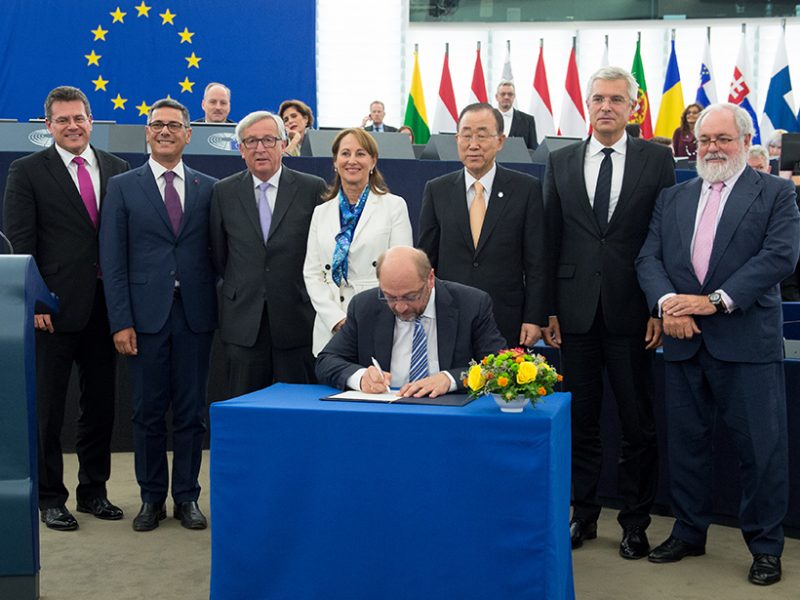
Martin Schulz signs Climate Agreement

Martin Schulz signs Climate Agreement

Mark Carney, the softly-spoken Canadian governor of the Bank of England, provides a rare focus for optimism right now. Indeed he has been dubbed by one pundit  ‘the only adult in the room’ while politicians play children’s games.

He can’t do much about the remorseless logic of the UK government putting border controls and immigration limits ahead of staying in the world’s largest trading block and what that will do for economic prospects; still less about the possible global consequences of Brexit’s American cousin, Trump, should that come to pass next month.

But he is intervening vigorously in the debate about opportunities arising from the move to a low carbon economy. His timing is excellent, with the EU Parliament fast-tracking its approval of the Paris Climate Agreement, meaning we are now over the threshold of 55 countries equating to 55% of global emissions needed for ratification. Continue reading